

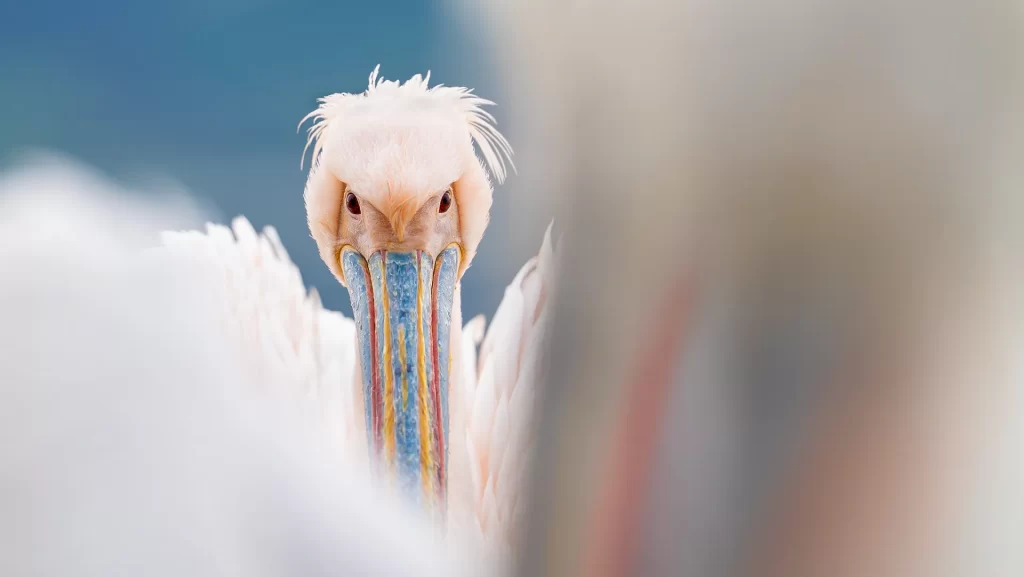
There are many species at Lake Kerkini. But there is only one that defines it.
The Dalmatian Pelican is not just another subject, it is the subject. The reason photographers travel across Europe, sometimes across the world, to stand in the cold before sunrise and wait for that one moment when everything aligns.
This is not a small, nervous bird disappearing at the first sign of movement.
This is one of the largest flying birds in the world, with a wingspan reaching up to 3 meters. When a pelican takes off from the water, you don’t just see it, you feel it. The sound of wings hitting the air, the weight, the slow, powerful motion… it’s something that stays with you.
And then there’s the look:
Everything about this bird feels… prehistoric. Almost unreal.
Here’s where things become interesting for photographers.
Pelicans at Kerkini are slow, deliberate, and expressive. They don’t rush. They don’t disappear in seconds. They give you time.
This is not chaotic wildlife. This is readable, photographable behavior, a rare gift.
What makes Kerkini special is not just proximity, it’s usable proximity.
With the right positioning and approach, pelicans come close enough for:
But don’t confuse this with “easy.” Because while the birds are there… the difference between a good photo and a great one still comes down to:
Kerkini gives you the opportunity. What you do with it… that’s on you.
Let’s be clear: you can photograph Dalmatian Pelican in other parts of its range. But not like this.
At Kerkini, a rare combination happens:
Put all this together, and you get something very rare in wildlife photography:
A place where you can learn, experiment, fail, adjust, and succeed, all within the same session.
After a few days at Kerkini, something shifts.
You stop chasing the pelican.
You start understanding it.
You begin to anticipate movement.
You recognize behavior before it happens.
You wait, instead of reacting.
And that’s when your photography changes.
The Dalmatian Pelican is not just the star of Kerkini.
It’s the perfect subject for photographers who want to move beyond luck and into control, intention, and storytelling.
Because here, for once, the subject gives you time. And time… is everything.
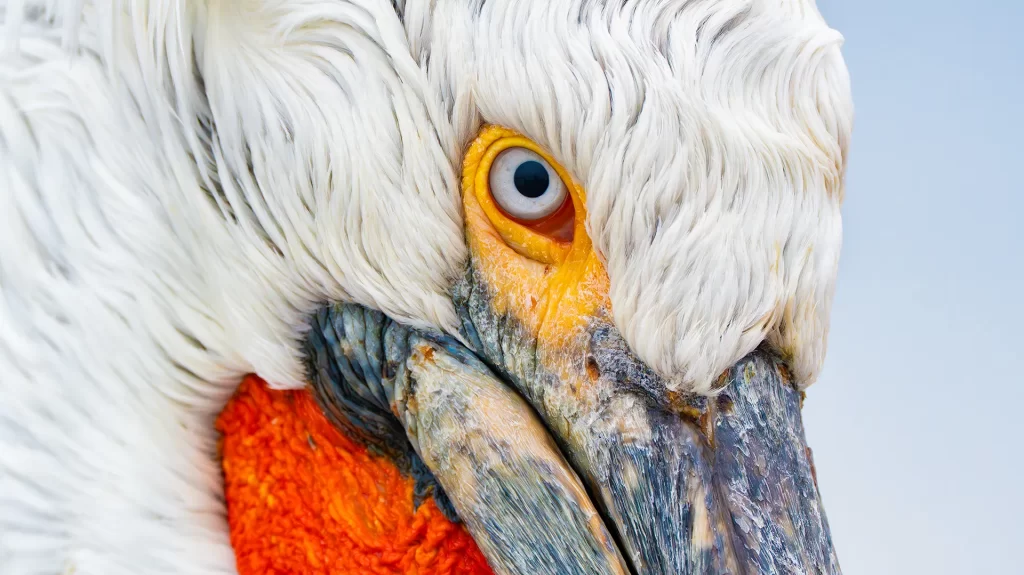
Wildlife photography is not just about images. It’s about choices. And at Lake Kerkini, those choices are very clear, whether you realize it or not.
Let’s start with something uncomfortable. Not every image you see from Kerkini reflects real wildlife behavior.
Some are the result of:
And yes, they can look spectacular.
But the question is simple:
What story do you want your image to tell?
At Kerkini, this is not a philosophical debate. It’s a practical choice.
Both exist. We don’t pretend otherwise. But they are not the same thing.
One is a performance.
The other is wildlife.
Here’s the irony:
When you stop forcing the moment… you start getting better ones.
Why?
Because:
A pelican gently taking a fish from the water, a quiet moment of preening, a subtle interaction between two birds.
These are not “loud” images.
But they are real.
And real always lasts longer.
Ethical photography is not just about what you shoot.
It’s about how you approach the subject.
At Kerkini, birds may appear tolerant. That doesn’t mean they should be taken for granted.
Every time you press the shutter, you make a decision. Not just about exposure or composition.
But about:
Because like it or not… images influence other photographers.
Most people won’t notice the difference between a “circus” image and a natural one.
But photographers do. And more importantly, you will.
After a while, the question changes from:
“Did I get the shot?”
to
“Did I earn it?”
At Lake Kerkini, we don’t eliminate reality. We understand it.
But we choose to guide photographers toward:
Because in the long run, those are the images that matter.
Kerkini isn’t a circus. It’s a controlled playground for wildlife photographers who value authenticity and patience.
Decide what kind of photography you want to produce: staged tricks, or true wildlife behavior captured in its natural glory.
Ethical wildlife photography is not about limitations.
It’s about intention.
Both are possible. But only one tells the truth.
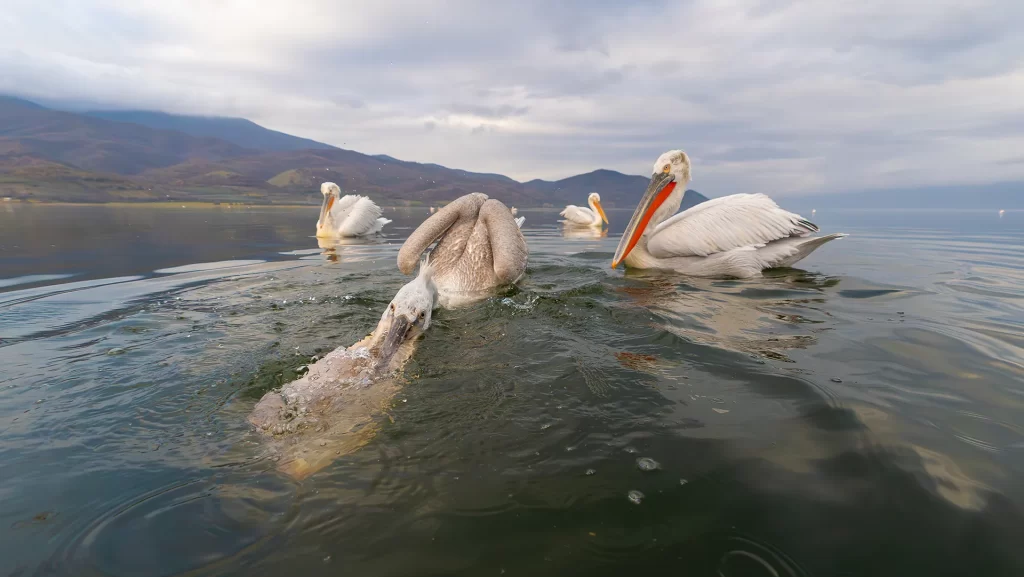
Now this is where things get… interesting 😄. Because almost everyone makes these mistakes at least once.
This is the classic.
Photographers arrive, show beautiful low-angle images they’ve seen online… then step into the boat, sit comfortably, or worse, stand, and shoot from above.
Result?
Fix: Get low. As low as possible. Water-level changes everything. Here it is possible!
Running after birds. Turning constantly. Shooting everything that moves.
End result:
Fix: Stop. Observe. Pelicans are slow. Read behavior. Let the moment come to you.
Great subject. Terrible light.
Fix: Always think: Where is the light? Then position yourself accordingly.
White birds + excitement = disaster.
Burned feathers. No detail. Irrecoverable files.
Fix: Slight underexposure is your friend. Protect the whites.
Ah yes… the famous line: “I hope tomorrow is sunny!”
No. You don’t.
Because:
Fix: Learn to love soft light, mist, haze. That’s where the magic is.
Shooting randomly without understanding what the bird is doing.
Fix: Watch first. Shoot second. Behavior tells you what happens next.
Trying to recreate the same iconic image everyone has.
Result:
Fix: Yes, learn the classics, but then look for something different.
Complaining about wind. Waiting for sun. Ignoring mist.
Fix: Use everything. Wind, rain, fog, they are tools, not problems.
Especially in wind.
Fix: Good technique, controlled movement.
Click, click, click… and move on.
Fix: Stay. Refine. Adjust. Repeat. Pelicans give you time, use it.
Most mistakes at Lake Kerkini are not about gear.
They are about:
Fix those, and your photography changes completely.
Text and photos: Iliuta GOEAN

