


There are places you visit… and places that completely change the way you see wildlife photography.
Lake Kerkini belongs firmly in the second category. Lake Kerkini is one of those rare places where everything aligns: light, distance, behavior, and when it does, the results are not just good… they’re exceptional.
In recent years, Kerkini has quietly established itself as one of the most important destinations in Europe for wildlife and nature photographers. Not because it’s heavily promoted, but because of what it consistently offers to those who understand how to work with it.
The Dalmatian Pelican remains the defining subject, one of the largest flying birds in the world, and a species that, in most places, keeps its distance. Here, under the right conditions and with the right approach, it allows for close, natural, and highly expressive encounters.
But Kerkini is not only about pelicans.
Cormorants, herons, egrets, flamingos, cranes and a wide range of wetland species bring variety and unpredictability to every session. Add changing weather, shifting water levels, and constantly evolving light, and you begin to understand why no two days ever feel the same.
Because that’s the truth about Kerkini: It rewards those who understand it.
This is not a destination for ticking species off a list.
It’s a place where patience, positioning, and reading behavior come together, and where, when everything clicks, you don’t just take photos… you create images that stay with you.

There are many beautiful places to photograph wildlife. Very few are built for photography.
Lake Kerkini stands out not just because of what you can see, but because of how you can photograph it.
In most locations, distance is the main limitation. At Kerkini, under the right conditions, that limitation almost disappears.
Species like the Dalmatian Pelican can be approached in a way that allows:
And this happens naturally, not through pressure, not through disturbance.
Great wildlife photography is rarely about luck. It’s about anticipation.
At Kerkini, the Pelicans show consistent, readable behavior. Feeding patterns, flight paths, social interactions… they repeat just enough to allow you to prepare.
That means:
Instead of reacting, you start predicting.
Light is everything and Kerkini delivers it in ways few places do.
Even on overcast days, the light often remains photography-friendly, not harsh or contrast-heavy.
One of the biggest advantages here is the perspective (please read that again and remember it!)
From properly handled boats, you can shoot:
This creates:
Many top wildlife destinations require:
Kerkini offers high-level opportunities without that complexity.
You get:
And that combination is rare.
Here’s the part that often gets overlooked: Kerkini is not just about being there, it’s about how you work it.
Positioning, approach, timing, reading behavior, adapting to light and water levels…
these are the elements that separate average results from exceptional ones.
And this is exactly where the difference is made between simply visiting Kerkini and truly photographing it.
Kerkini is not just a beautiful location. It’s a place where conditions align in favor of the photographer.
Where wildlife, light, and access come together in a way that allows you to go beyond documentation, and create intentional, high-quality images.
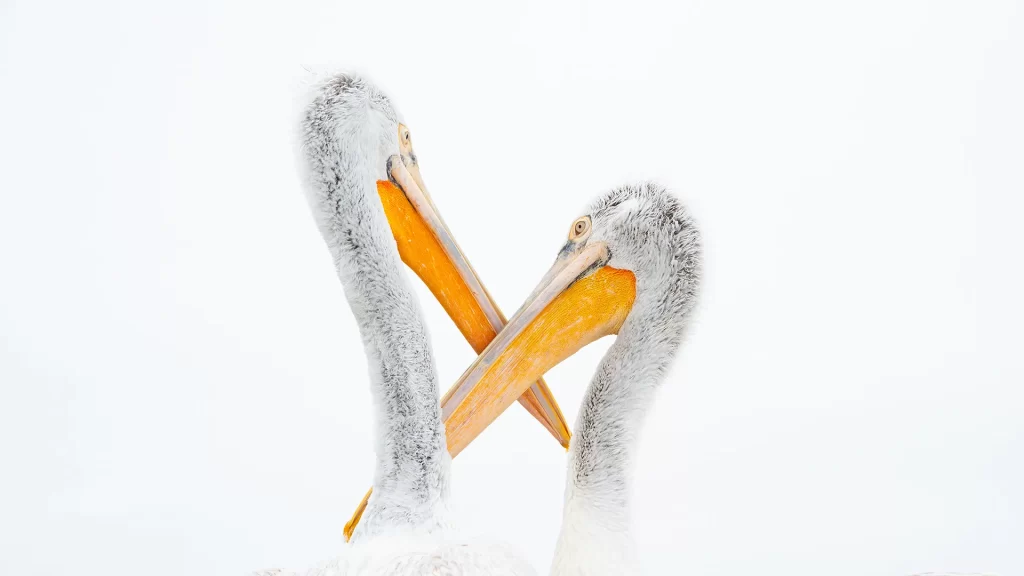
Photography at Lake Kerkini is not just about being in the right place, it’s about being in the right moment, witnessing the ever-changing beauty of wildlife in motion.
For photographers, timing can dramatically change your images, especially when photographing the iconic Dalmatian Pelican.
Here’s how the magic unfolds through the season:
Photographers at this time witness diverse colors in one shot, capturing the transitional beauty of the species.
This is my personal favorite for photography: diversity, color variety, and mood in the same frame.
December and February are therefore ideal for photographers who love variety, while January suits those seeking a classic, uniform visual impact.
Text and photos: Iliuta GOEAN

